
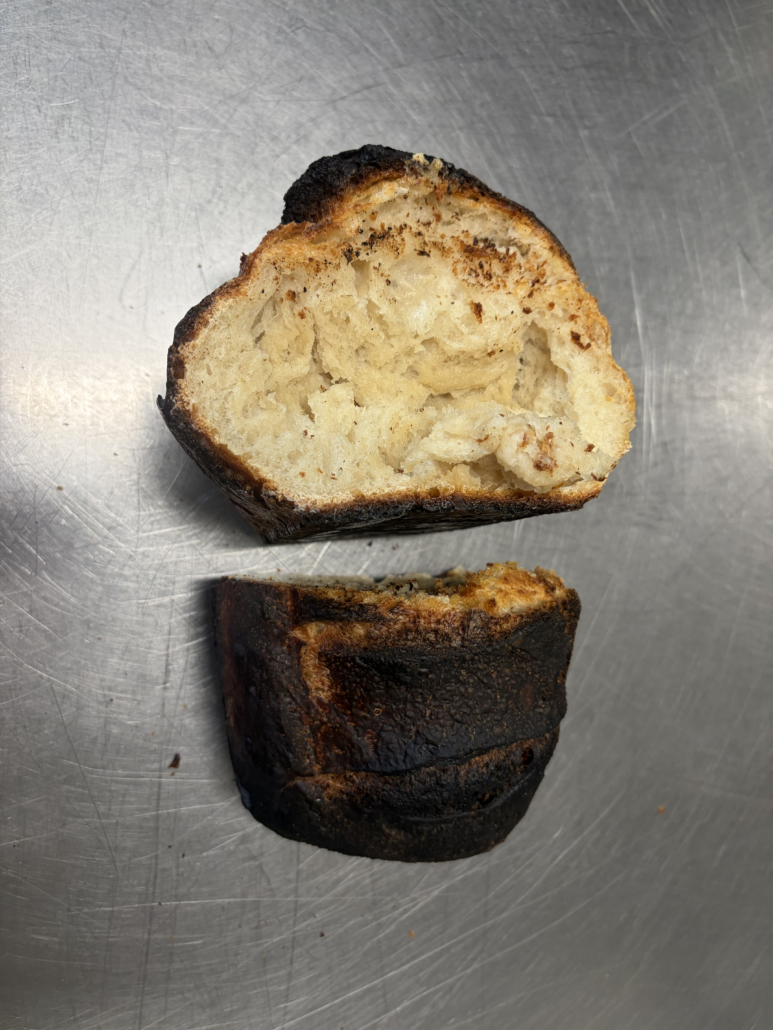
DOH!
Some days and seasons of life feel like a dumpster fire.
You devoted your entire heart to the situation. You prepare. You plan. You think five steps ahead. You carry the weight of it. You give your time, your energy, your patience, and every ounce of yourself you have left. You do everything you know how to do. You show up. You fight for it. You hope.
And still, sometimes, the thing you poured out your whole heart to is the very thing that leaves it hurting. It feels like you gave everything you had, only to be left standing in the smoke and ashes of what you were trying so hard to protect.
I’ve seen this lesson play out countless times in the kitchen. A recipe can be measured perfectly. The ingredients are fresh. The timer is set and correct. Still, something unexpected changes the outcome. The kitchen has a way of reminding me that effort doesn’t always guarantee the result hoped for.
That’s one of the reasons sourdough bread has become so meaningful to me. Of all the things I’ve made in the kitchen, bread has taught me the most about expectations, patience, and letting go of the illusion of control. Sourdough is forgiving but refuses to be rushed. It demands humility to start over when a loaf doesn’t turn out the way hoped for. Our bread takes more than 24 hours from start to finish. The process begins long before it reaches the oven. The starter has to be cared for. The dough has to be handled with intention. Temperature, timing, and technique all matter.
However, sourdough also requires flexibility. Every batch is different. You learn to pay attention, make adjustments, and accept that the outcome does not always unfold the same way.
Even after all that preparation, sometimes the final result is not what we hoped for.
In our kitchen, we bake six loaves at a time. Once those loaves are gone, it is another 24 hours before we bake again. There is no quick reset button.
Kitchens are a lot like life.
Each day is full of competing priorities. The timer goes off while the grill is full, tickets are stacking up, guests are waiting, and the team needs you. The bread that took more than 24 hours of care becomes one more thing asking something from you.
And then someone notices the loaves.
They are baked longer than intended.
In an instant, the mind begins to rewrite the day. The batch of bread that didn’t turn out perfectly becomes more memorable than everything that went well.
I’ve watched how quickly a single disappointment can crowd out every success. One mistake has a way of becoming the loudest voice in the mind. I wonder how often we do the same thing in everyday life. A burnt batch of bread is only one moment in the process. The same is true for us. A mistake, a difficult season, or an unexpected twist may shape our journey, but it will never define everything that comes next. How we respond along the way is what matters.
The bread has taught me that mistakes are information, not identity.
The question is not always, “What went wrong?”
A better question is, “What is this trying to teach?”
Maybe the lesson is to slow down.
Maybe it is to create a better system.
Maybe it is recognizing that more support is needed.
Perfection cannot be the goal. Growth must be. The goal is to learn, adapt, and keep moving forward.
I have worked in other kitchens, but this is the first kitchen where I have had the privilege of supporting a team beyond my own role. It has taught me something I hope I never forget:
The most resilient teams are not made up of people who never make mistakes. They are made up of people who understand that mistakes happen, who learn from them, and who help each other move forward.
Nobody wants to burn the bread.
But when it happens, we have a choice.
We can let that moment define us. Or we can learn from it and keep moving.
Because the truth is, the bread may be a little more overcooked than intended, but it is not worthless.
The more I work with bread, the more I realize people are shaped in much the same way.
Like dough, we are stretched, folded, and shaped by the challenges we face. Our lives are affected by time, pressure, and circumstances. Each of us can prepare well, care deeply, and still end up somewhere different from what we expected.
Different does not mean ruined.
Imperfect does not mean worthless.
Often, the outcomes we wish we could rewrite become the lessons we carry with us.
The stretching, folding, and shaping continue throughout our lives.
We learn.
We adjust.
We begin again.
One loaf of bread never tells the whole story.
Neither does one mistake.
Whether it’s in a kitchen, a workplace, a classroom, or around the dinner table, the healthiest environments have something in common. People are given room to learn. Mistakes become lessons instead of labels. Growth matters more than perfection.
Years from now, no one will remember every perfect loaf. They will remember the moments when they were met with patience, encouragement, and grace, and I hope they carry those lessons forward, offering that same compassion to themselves and to others throughout their lives.
